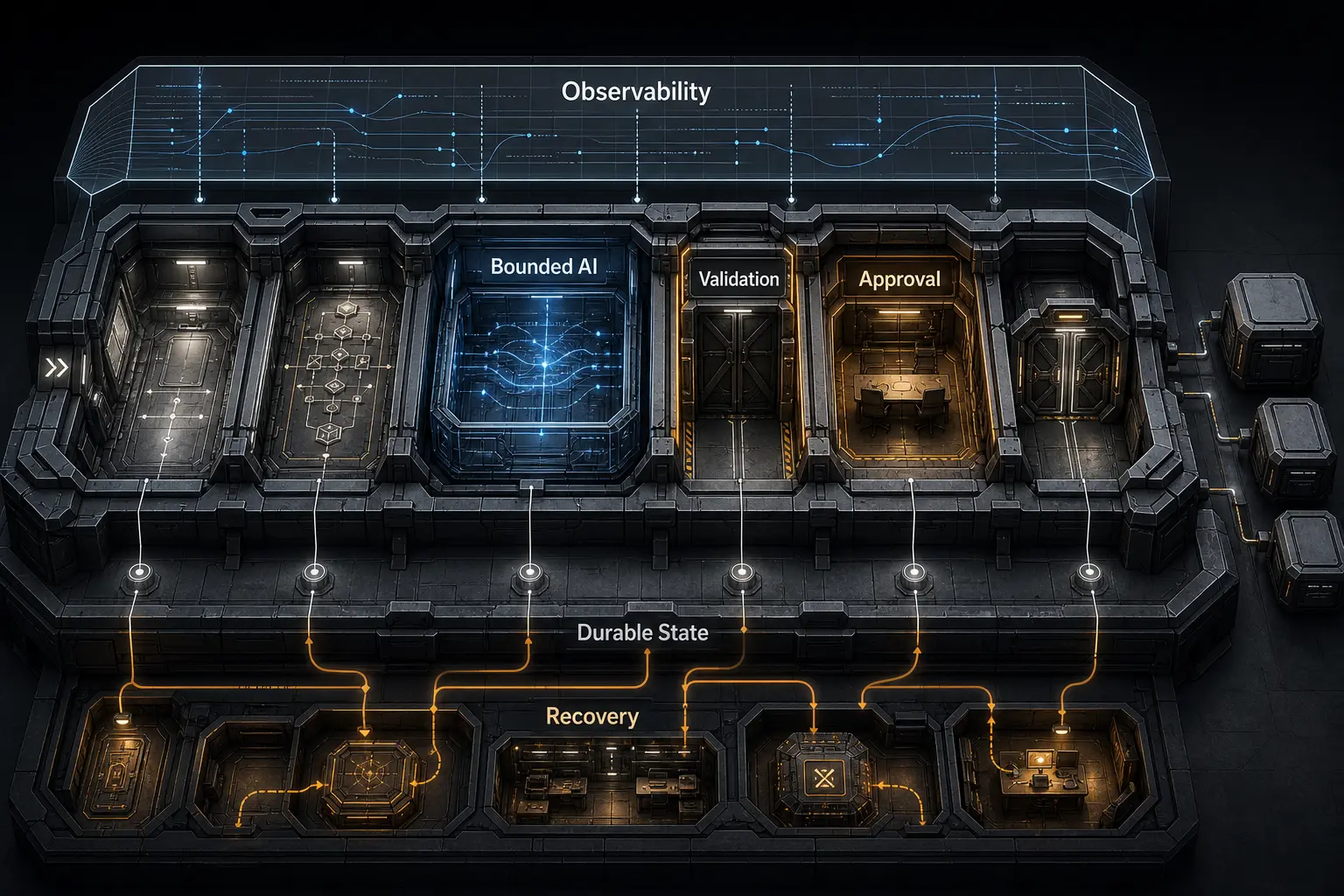
AI automation architecture is the structure that coordinates triggers, business logic, AI decisions, integrations, state, controls, and recovery. Reliable systems isolate uncertain decisions, preserve execution state, validate outputs, control side effects, and make failures observable and recoverable. Adding workflow steps does not create dependable architecture; defining how each step behaves under normal and abnormal conditions does.
A prototype may succeed on its expected path yet fail when a webhook is delivered twice, an API times out, input data is malformed, an AI response violates its schema, or an approval remains unanswered. Moving beyond that prototype requires a component model, explicit decision boundaries, durable execution patterns, and an operating plan that supports recovery rather than merely detecting errors.
Table of Contents
- AI Automation Architecture: A Reliability-First Model
- Define System Boundaries and Component Responsibilities
- Design Execution, State, and Data Flow
- Control AI Decisions and Human Approvals
- Design for Failure and Recovery
- Operate and Evolve the Architecture
- FAQ
- What to Do Next?
AI Automation Architecture: A Reliability-First Model
A production-oriented automation architecture is best understood as a set of responsibilities. It needs an ingress point for triggers or webhooks, input normalization, orchestration, deterministic business rules, bounded AI decisions, integration adapters, state storage, validation, approvals, and observability. These responsibilities can exist as logical boundaries inside one automation platform. They do not automatically justify separate services, microservices, or a distributed system.
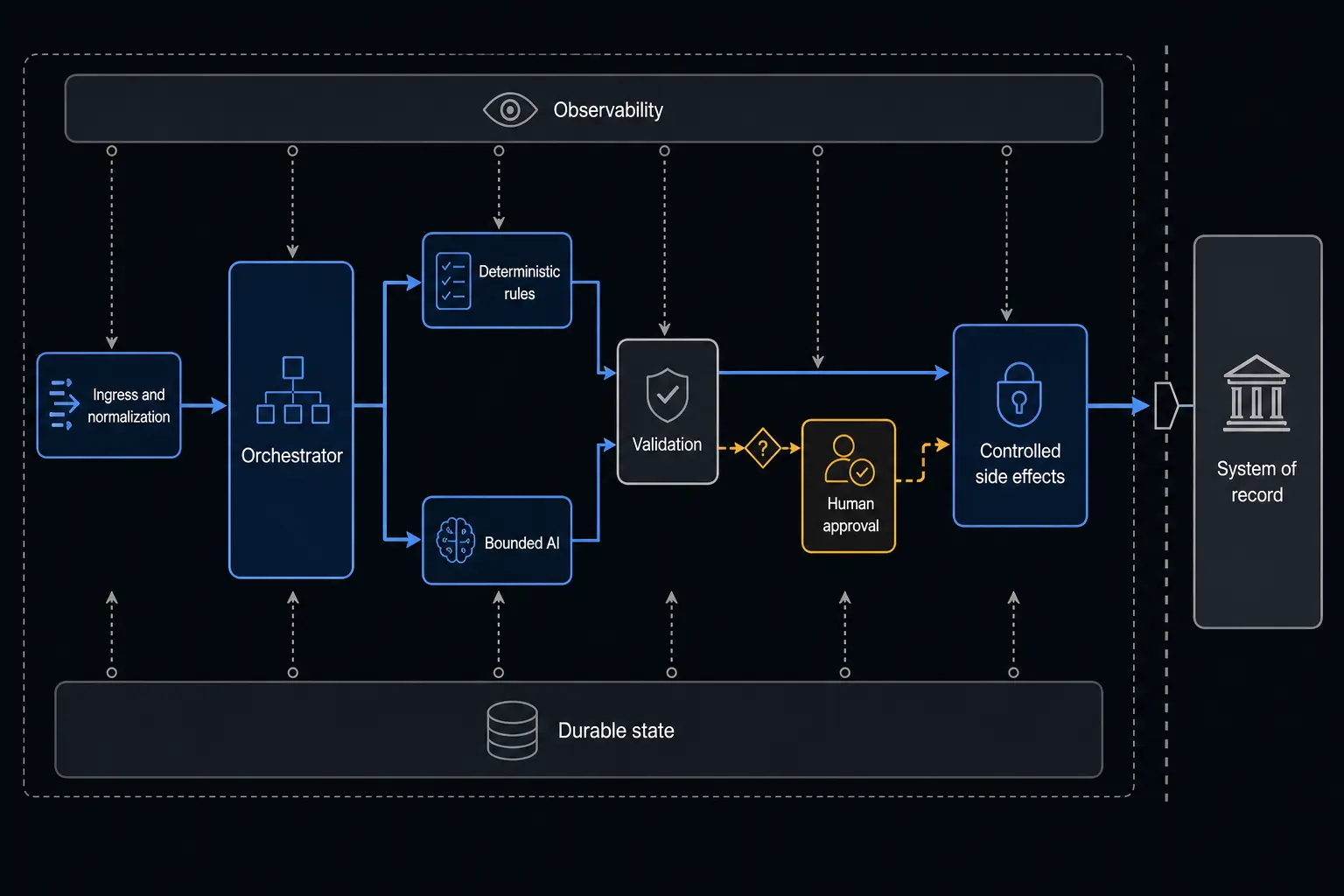
A typical execution path receives an event, establishes its identity, validates and normalizes the input, loads relevant state, applies rules or requests an AI decision, validates the result, performs approved side effects, records the outcome, and exposes the run status. Each transition should answer three questions: what is allowed to happen next, what evidence confirms that it happened, and what happens if it fails?
Consider a hypothetical request-intake workflow. A webhook receives a form submission. Schema validation confirms that required fields exist, while deterministic rules reject unsupported request types. An LLM classifies valid free text into a fixed set of categories. A policy check decides whether the classification can proceed automatically or needs review. An adapter creates a record in a downstream application, and the workflow stores every significant status transition.
The diagram for that AI workflow architecture may look simple, but reliability comes from five underlying properties:
- Traceability connects an incoming event to its decisions, actions, and final outcome.
- Idempotency prevents repeated delivery or recovery attempts from duplicating an effect.
- Bounded uncertainty limits where probabilistic AI output can influence execution.
- Recoverability provides deliberate ways to retry, resume, compensate, or resolve exceptions.
- Controlled side effects protect consequential actions from accidental repetition or unchecked decisions.
It is also useful to separate control from execution. Prompts, schemas, routing policies, credentials, and configuration govern how work should run; execution processes a particular request using those definitions. This conceptual control plane does not need to be a separate product, but its changes should be versioned and governed separately from individual workflow runs. Most importantly, architecture includes failure behavior. A diagram that describes only the happy path describes intent, not an operational system.
Define System Boundaries and Component Responsibilities
Begin with the operational process, not the automation tool. Identify the initiating event, required inputs, decisions, handoffs, outputs, exceptions, and completion conditions. This reveals what the system must coordinate before implementation details constrain the design.
For the intake example, the form platform produces the event, the orchestrator owns run status, an AI service returns a structured classification, a database preserves durable execution state, a reviewer handles uncertain cases, and the downstream application owns the final business record. That boundary matters: the automation coordinates the process, but it should not quietly become a competing source of truth for records owned elsewhere.
A workflow orchestration architecture needs one clear owner for sequencing. The orchestrator determines which step runs next, tracks status, applies workflow timeouts, pauses for approval, and routes exceptions. Integration adapters have a narrower responsibility: they translate internal requests into an external API’s authentication method, field mapping, response schema, and error vocabulary. The adapter should not independently invent business policy, while the orchestrator should not duplicate low-level integration behavior everywhere an API is called.
Stable conditions belong in deterministic rules wherever practical. Required fields, permissions, permitted destinations, threshold checks, and irreversible-action policies are easier to test and audit as explicit logic. AI belongs where the process requires interpretation of variable language or other uncertain inputs. This separation prevents a model from deciding matters already expressed as firm policy.
Every boundary needs a contract: expected input and output schemas, allowed values, timeout behavior, error categories, and retry ownership. In an AI integration architecture, that applies to both model-facing services and conventional business APIs. Structured output does not remove the need for a contract; it makes parts of that contract machine-checkable.
Side effects deserve special attention. Sending a message, creating a record, changing a status, publishing content, or initiating a financial action alters the world outside the workflow. Define which component is authorized to perform each action and how repetition is prevented. If both an orchestrator and an integration adapter independently retry a record-creation request, one temporary timeout can produce duplicate records. Modularity helps only when responsibilities remain unambiguous.
Design Execution, State, and Data Flow
Every workflow run should have a stable run identifier. Retain correlation identifiers supplied by upstream systems, such as an event ID or request ID, because they connect the automation’s history to external records. Identity is the foundation for deduplication, diagnosis, and safe recovery.
Workflow state and business data are different. Workflow state records execution progress: received, validated, awaiting decision, awaiting approval, executing, completed, failed, or cancelled. Business data describes the underlying request and normally remains authoritative in its designated system of record. Status names should reflect the actual process rather than becoming a generic list copied into every automation.
Idempotency means that processing the same event or retrying the same operation does not repeat an irreversible effect. It often requires several controls working together:
- Deduplicate incoming events using a stable source identity.
- Assign idempotency keys to side-effecting operations where the receiving system supports them.
- Record action attempts, identifiers, and confirmed outcomes before a run can re-enter the step.
- Reconcile ambiguous outcomes instead of assuming that a missing response means failure.
Suppose the form platform sends the same webhook three times because it did not receive a timely acknowledgment. The automation system design should recognize the repeated event, acknowledge delivery safely, and associate each delivery with one logical run. It should not classify the request three times and create three downstream records.
Execution can remain synchronous when work is short, low risk, and unlikely to exceed request timeouts. Long-running tasks, rate-limited integrations, delayed approvals, and temporary outages need durable asynchronous handling. A queue can buffer work, limit concurrency, and absorb temporary service pressure, but it is not a universal requirement. Its value appears when work must wait or when producers can generate events faster than consumers can process them.
Durable state becomes particularly important during approval. If a run pauses for two days, it should resume from the approved transition rather than restart classification and every preceding side effect. Preserve the normalized input, relevant decision output, validation results, action receipts, and transition history needed to understand the run. Logs alone are not durable state; they explain events but should not be the only mechanism for determining what the workflow must do next.
State also introduces concurrency risks. Two runs may attempt to update the same request, or an approval may arrive after the request has been cancelled. Use version checks, conditional updates, locks, or other concurrency controls appropriate to the storage layer. Set retention and access boundaries as well. Indefinitely retaining all prompts, payloads, and model responses that may contain sensitive data increases security and privacy risk, and security guidance recommends logging only necessary information with defined retention periods rather than keeping everything forever.
Control AI Decisions and Human Approvals
An LLM call is not automatically an agent. A workflow that sends text to a model for classification is an AI-assisted workflow. An agentic workflow delegates meaningful choices about tools, steps, or actions to a model within defined boundaries. That distinction matters because autonomy introduces additional state, permissions, failure modes, and oversight requirements.
Use AI for semantic interpretation, extraction from variable text, classification, summarization, or bounded recommendations where fixed rules cannot adequately express the task. Keep stable policy, permissions, thresholds, and conditions for consequential actions deterministic. Effective AI orchestration coordinates these forms of computation rather than asking the model to control the entire process.
The intake classifier should return a defined structure, such as a category, proposed destination, supporting rationale, and missing-information flags. Validate syntax, schema, required fields, allowed values, and business constraints immediately after the response. A syntactically valid result can still be factually wrong, unsupported, or inappropriate to act on. “The model produced valid data” and “the system can safely execute this decision” are separate gates.
Assign decisions according to ambiguity, consequence, and reversibility. A low-impact draft can often proceed with lightweight checks because a person can revise it later. Deleting a record, publishing externally, changing permissions, or initiating a payment carries a different risk. Missing evidence, policy conflict, or an unknown routing destination should trigger deterministic rejection or human review rather than creative model interpretation.
Model-provided confidence should not be treated as a calibrated probability without evidence that supports that interpretation. Approval policy is stronger when it considers validation failures, missing information, policy conflicts, action impact, and reversibility. Confidence can be one input, but it should not become a universal safety switch.
Human review must itself be designed as a workflow. The reviewer needs the original input, proposed result, validation flags, relevant evidence, and a clear set of permitted actions. The architecture must define approval, rejection, modification, expiration, reassignment, escalation, and resume behavior. An unanswered request cannot remain in an undefined waiting state indefinitely.
If the design genuinely needs an agent, constrain its available tools, permitted actions, accessible state, step limits, and escalation conditions. The agent should not gain broad integration access simply because it can choose its next action. Within a reliable AI workflow architecture, autonomy is a bounded capability, not an exemption from contracts and policy.
Design for Failure and Recovery
Failures should be classified before recovery is chosen. Invalid input, expired credentials, rate limits, timeouts, temporary outages, permanent integration rejections, invalid AI output, policy conflicts, and internal defects do not have the same remedy. Routing every error into one retry loop hides the condition and often makes it worse.
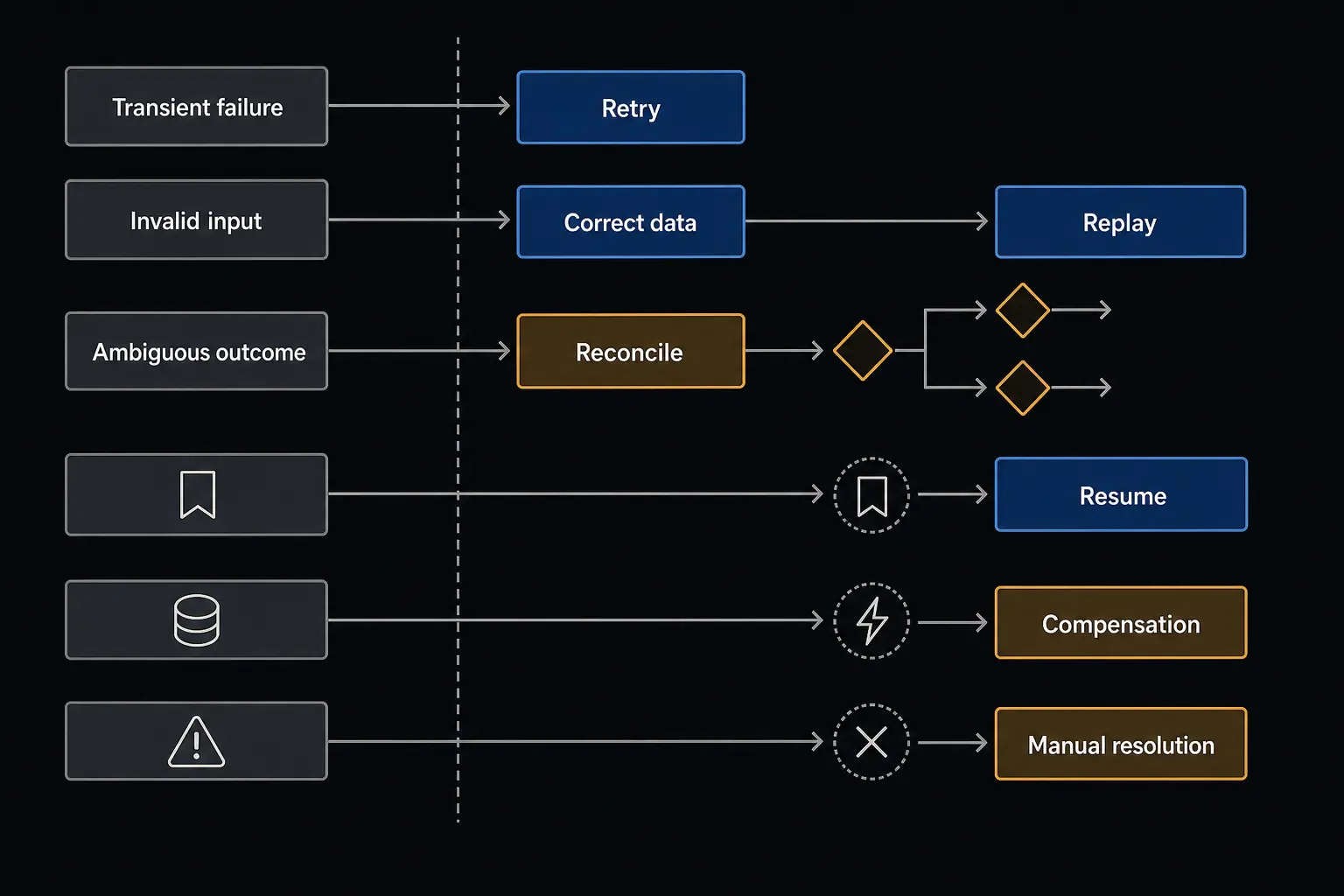
Retry only errors likely to be transient, using bounded attempts, delays, and backoff. Validation errors need corrected data. Permission failures need a credential or access change. Policy conflicts need a different decision. Immediate repetition changes none of those conditions.
Retries also require idempotency. Imagine that the downstream record-creation request times out after reaching the external application. The record may exist even though the automation received no response. Blindly retrying can create a duplicate. A safer sequence checks the stored idempotency key or queries the downstream system for the action outcome, then marks the step complete, retries safely, or routes the ambiguous case for review.
Define timeouts for both integrations and the workflow as a whole. No API call, AI request, or approval should keep a run active indefinitely. When retries are exhausted or an error is non-retryable, move the run into an inspectable failed state or exception queue with enough context for a person or recovery process to act.
Recovery has several distinct forms:
- Replay safely reprocesses an event, usually after a defect or dependency has been corrected.
- Resume continues from the last confirmed checkpoint without repeating completed work.
- Compensate performs a deliberate counter-action when true rollback is unavailable.
- Manual resolution records a human decision for a case the system cannot settle safely.
These terms are not synonyms. Distributed actions across external systems rarely share one transaction. If a message was sent and a record was created before the final status update failed, rolling back the database alone does not undo those external effects. Recovery depends on action receipts, safe checkpoints, reconciliation, and deliberate compensation where the external service supports an appropriate counter-action.
Failure and recovery paths are part of automation architecture, not secondary operational details. Notifications should reflect that design. Alert on conditions that need intervention or indicate a pattern, while allowing expected transient failures to recover without noise. Too little notification creates silent backlogs; too much teaches operators to ignore the system.
Operate and Evolve the Architecture
Production operation begins with visibility into workflow runs. Useful observability includes run identity, current state, step timing, attempt count, integration response category, AI validation outcome, approval status, and final disposition. This makes it possible to see where work is waiting and why, rather than merely knowing that an error occurred.
Logs, metrics, and audit records serve different purposes. Logs explain individual events and provide diagnostic context. Metrics reveal patterns such as rising latency, exception volume, or approval backlog. Audit records document consequential decisions and actions: who approved a result, which policy version applied, and what external effect followed. One cannot reliably substitute for the others.
Errors should identify the failed component, category, relevant correlation identifiers, attempt number, and safe diagnostic context. Avoid placing credentials or unrestricted sensitive payloads in logs. Use least-privilege access, managed secrets, selective logging, and retention policies suited to the data’s sensitivity and operational value.
Testing should cover more than the successful route. Test deterministic rules, schemas, validation, integration contracts, representative AI outputs, and end-to-end scenarios. Include malformed inputs, duplicate events, slow dependencies, invalid structured output, expired approvals, partial completion, and ambiguous timeouts. Failure-path tests often expose architectural gaps that ordinary workflow demonstrations never reach.
Version prompts, schemas, routing rules, policies, integration mappings, and workflow logic. A prompt change can alter classifications even when the workflow diagram remains untouched. Versioning makes behavior traceable and supports controlled rollback where practical. Reusable components and subworkflows are valuable when they establish stable contracts, not merely when they make the canvas look tidy.
Scale according to the actual constraint. If completion time rises, the bottleneck may be a rate-limited downstream API or growing approval queue rather than the AI call or orchestration platform. Concurrency controls, buffered execution, revised review criteria, or integration changes should follow evidence about the pressure point. Volume, latency, database contention, reviewer capacity, and exception rates are different scaling problems.
A lightweight architecture review should verify ownership, run identity, state transitions, authoritative data sources, idempotency, validation, retry ownership, recovery paths, approval behavior, observability, security, and maintenance responsibility. Complexity should match the workflow’s risk, but none of these questions should be left implicit.
FAQ
What is the difference between AI automation architecture and a workflow?
A workflow describes a sequence of work. Architecture defines the responsibilities, boundaries, state, contracts, controls, and recovery mechanisms that make one or more workflows dependable. A visual flow can represent part of the architecture, but it does not prove that duplicate events, partial failures, or interrupted approvals are handled safely.
When should AI be replaced with deterministic rules?
Use deterministic rules when conditions are explicit, stable, testable, and consequential, such as permissions, required fields, thresholds, and permitted actions. Use AI when variable or unstructured information requires interpretation, then place deterministic schemas, validation, policies, and action controls around the result.
Does every AI automation need a database and queue?
No. A short, low-risk workflow may rely on platform-provided execution storage and synchronous processing. Durable state becomes important for long-running work, approvals, recovery, and auditability. Queues are useful when work needs buffering, concurrency control, rate-limit management, or resilience during temporary service pressure.
How should AI automation architecture handle duplicate events?
Use stable event identity, deduplication at ingress, idempotency keys for side effects, and recorded action outcomes. Return acknowledgments without starting a second logical run for the same event. Duplicate delivery is a normal integration condition to design for, especially with webhooks and retries.
When does an AI workflow need human approval?
Approval should depend on consequence, reversibility, ambiguity, missing information, and policy risk. The approval step also needs defined reviewer context, permitted actions, deadlines, reassignment or escalation behavior, and a safe transition for resuming or terminating the run.
What to Do Next?
Start with one bounded workflow and its operational outcome. Map the event source, inputs, decisions, external systems, side effects, exceptions, and completion conditions. Mark each decision as deterministic, AI-assisted, or human, then define run identity, state transitions, validation, authoritative data ownership, and recovery responsibility.
Create a one-page component and data-flow map, a state-transition list, contracts for AI and integration outputs, and a failure matrix covering retry, resume, compensation, and manual resolution. Test the design against duplicate events, invalid AI output, integration timeouts, partial completion, and interrupted approvals before adding branches, agents, or infrastructure. Those scenarios reveal whether the architecture controls uncertainty or merely hides it behind a successful demonstration.
Turn a Reliable Design Into a Bounded Workflow
Learn how to start with deterministic paths, add one validated AI task, test failure handling, and increase autonomy carefully.
After defining boundaries and recovery, this article offers a staged path for implementing those controls in a bounded business workflow.
Read the article