The best opportunities for AI automation for business are repetitive and consequential enough to create meaningful value, yet structured and observable enough to control. Frequency alone is not a sufficient reason to automate. Variable inputs, frequent exceptions, costly errors, weak integrations, and ongoing supervision can turn an apparently efficient workflow into a system that creates more work than it removes.
A sound evaluation starts by mapping the current process, measuring its burden, identifying where judgment is genuinely required, and choosing the least complex architecture that addresses the real constraint. The framework below covers candidate discovery, process scoring, architecture choices, impact estimation, and pilot design so that automation decisions can be tested against operational evidence rather than software features or demonstrations.
Table of Contents
- What AI Automation for Business Actually Means
- Map Processes Before Choosing Tools
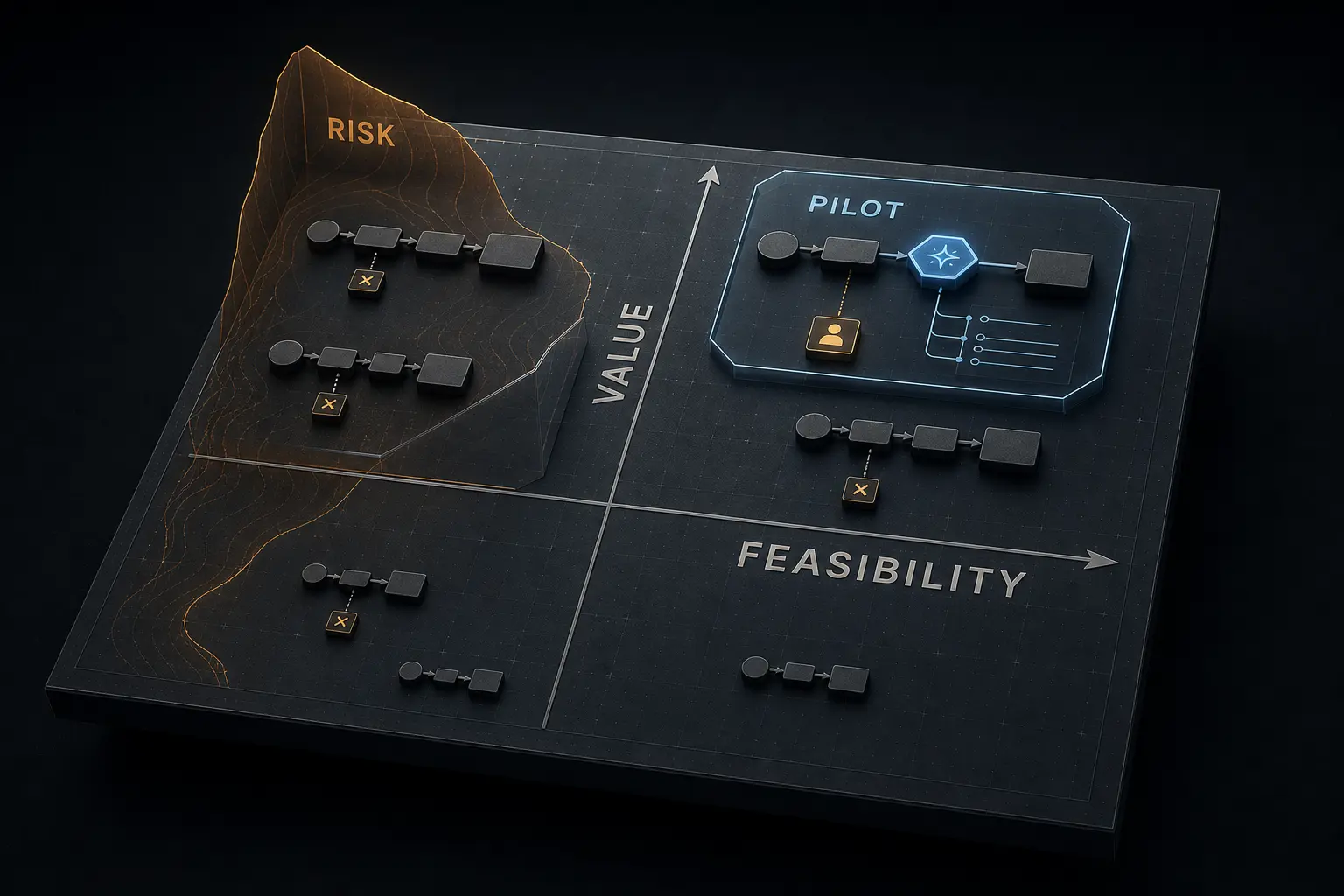
- Score Processes for Value and Feasibility
- Choose the Least Complex Automation Design That Works
- Estimate Impact Without Ignoring Hidden Costs
- Pilot, Measure, and Expand Without Losing Control
- FAQ
- What to Do Next?
What AI Automation for Business Actually Means
AI automation for business is not a single product or technical pattern. Business automation is a system that receives information, applies rules or models, triggers actions, and handles the resulting outcomes with less manual intervention. AI belongs inside that system when part of the process involves variable language, documents, images, classification, extraction, summarization, or another form of bounded judgment that fixed rules cannot handle reliably.
Three categories are commonly conflated. Deterministic automation follows explicit instructions: if a form contains a particular account type, route it to a defined queue. An AI-assisted workflow uses a model for a limited step, such as extracting fields from an email, while surrounding that step with conventional business logic. An agentic workflow delegates meaningful choices about tools or sequences of actions to a model. Adding an LLM call to an automation does not make it an agent.
Consider an incoming operations-request process. A fully manual version requires a person to read every message and decide where it belongs. A deterministic version can route requests submitted through a structured form because the relevant category is already supplied. If requests arrive as free-form email, a model could classify their subject, urgency, and required team. The workflow could then apply rule-based assignment and send uncertain or sensitive cases to a review queue.
The third design is not automatically better than the second. If structured fields are available and routing rules are stable, conventional automation will usually be easier to test, predict, and maintain. AI business automation is most useful where input variability is unavoidable and model output can be constrained before it affects the wider operation.
This introduces controlled uncertainty. Model outputs are probabilistic, even when formatted consistently. Production workflows therefore need validation, acceptance rules, explicit failure paths, and human review where the consequences justify it. The objective is not to make one isolated task look faster. It is to improve the end-to-end process without transferring the removed effort into correction, supervision, and recovery.
Map Processes Before Choosing Tools
To automate business processes with AI, begin with the process rather than the tool. Look for recurring work that creates queues, duplicate data entry, status chasing, missed handoffs, delayed decisions, inconsistent classification, or avoidable escalation. These signals indicate operational friction, but they do not yet establish its cause.
Map each candidate from its trigger to its final business outcome. A useful process map records:
- The event that starts the process and the outcome that completes it.
- The inputs, outputs, systems, and people involved.
- The business rules, decisions, approvals, and ownership boundaries.
- The standard path, exception paths, wait states, and failure conditions.
- Where information is copied, transformed, checked, or re-entered.
This end-to-end view separates business workflow automation from automating a disconnected task. A process might take four days from request to completion while containing only twenty minutes of active handling. If most of the delay comes from approval queues, automating five minutes of data entry will not materially change cycle time. It may still help, but it does not address the dominant constraint.
A hypothetical supplier-invoice process illustrates the point. An invoice arrives by email, its fields are extracted, the supplier and purchase order are matched, discrepancies are reviewed, approval is requested, and approved data is entered into a financial system. The standard path looks highly automatable. Yet if many invoices have missing references, quantity disagreements, duplicate submissions, or approval exceptions, the economics depend on the exception path rather than the clean demonstration.
Mapping also exposes unstable processes. If two teams disagree about ownership, staff apply undocumented rules, or the desired outcome changes from case to case, automation will encode the ambiguity rather than resolve it. Simplify the process, clarify decision rights, and improve input quality first. A poorly defined process does not become well designed because its uncertainty has been moved into software.
Score Processes for Value and Feasibility
Candidate selection should examine three dimensions: operational value, implementation feasibility, and consequence of failure. This is more useful than ranking tasks by how repetitive or annoying they appear. A frequent task can still be a weak candidate if inputs are inaccessible, exceptions dominate, or mistakes create disproportionate harm.
Operational value includes process volume, active handling effort, avoidable waiting time, rework, consistency, and the effect on service or revenue. Feasibility includes data accessibility, input quality, rule clarity, integration access, process stability, output structure, and testability. Risk includes customer impact, compliance sensitivity, reversibility, error consequences, and whether approval must occur before an action.
A practical scorecard can rate each factor on a small, consistent scale. The weighting should reflect the operation: a regulated process should weight consequence and auditability more heavily than a low-risk internal classification task. The score is not an objective truth. It is a disciplined way to expose assumptions and compare candidates using the same criteria.
Place the results into four broad groups:
- High value and high feasibility: strong pilot candidates, provided their risks are controlled.
- High value and low feasibility: potentially worthwhile, but dependent on process redesign, better data, or integration work.
- Low value and high feasibility: easy to build, but unlikely to justify ongoing ownership.
- Low value and low feasibility: poor candidates regardless of technical novelty.
Compare three hypothetical processes. Copying approved form data between two systems may be valuable and easy to test, but it probably needs deterministic integration rather than AI. Classifying free-form customer messages could suit bounded AI assistance because the inputs vary while the output categories remain defined. Autonomously resolving sensitive account disputes may have theoretical value, but the consequences of a wrong action, contextual complexity, and approval requirements make it a poor early candidate.
A proposal for business process automation with AI should also pass a readiness gate. Do not proceed if the process has no accountable owner, source data cannot be obtained, success has not been defined, or nobody owns failed and uncertain cases. For AI in business operations, modest scope, observable behavior, reversible actions, and dependable data are often more valuable than broad autonomy.
Choose the Least Complex Automation Design That Works
Once a credible candidate has been identified, escalate the design gradually. Improve or remove unnecessary process steps first. Use deterministic rules where the logic is explicit. Introduce bounded AI only for variability that rules cannot handle effectively. Consider limited agentic behavior only when the system must make constrained choices that cannot be represented more safely as a fixed sequence.
Deterministic automation is appropriate for known transformations, scheduled actions, exact validations, fixed routing rules, API transfers, and explicit approval states. An LLM or another model is appropriate for interpreting variable content when the required output is narrow enough to validate. If model-generated information will enter a database, call an API, or control branching, it should be returned in a defined structure rather than treated as unrestricted prose.
Structured output does not guarantee correct output. Schema validation can confirm that a request category is present and properly formatted; it cannot prove that the category accurately reflects the source message. Acceptance criteria must therefore address both structure and meaning. Depending on the task, this may involve allowed-value checks, reference-data matching, deterministic cross-checks, tested acceptance thresholds, or human review.
A service-intake workflow might contain the following components:
- A trigger that receives an email and retrieves relevant account information.
- A model call that extracts request type, urgency, and key details into a defined schema.
- Validation that rejects missing, malformed, or unsupported values.
- Business rules that route accepted low-risk requests to the appropriate queue.
- A review path for ambiguous, sensitive, or contradictory cases.
- Logging, limited retries, and fallback handling when a service or integration fails.
Human review can sit at different points. Approval before action is appropriate where an error is consequential or difficult to reverse. Review after action can work for low-risk, recoverable outcomes. Exception-only review becomes credible after the workflow has demonstrated stable performance within a narrowly defined case set. During a pilot, reviewing every proposed action is often useful because it produces correction data without granting premature autonomy.
Agentic behavior should be reserved for workflows that genuinely require bounded tool selection, state, feedback, or adaptive multi-step decisions. If the steps and branches are already known, a fixed workflow will usually be easier to secure, observe, test, and debug. Good AI automation solutions often combine deterministic orchestration, one constrained model-assisted step, and explicit human control rather than relying on a single autonomous system.
Estimate Impact Without Ignoring Hidden Costs
Impact estimation begins with a baseline. Record current volume, active handling time, waiting time, error frequency, correction effort, exception rate, and the service outcome that matters. Without a baseline, it is impossible to distinguish operational improvement from a workflow that merely appears functional.
Calculate gross benefit only for the share of cases the proposed system can handle successfully. If routine requests qualify for straight-through processing while uncertain cases still require review, do not apply the theoretical time saving to the entire volume. Then subtract implementation, integration, model or service usage, monitoring, human review, maintenance, and exception-handling costs.
A compact decision model is:
Expected net value equals expected operational benefit minus total ownership cost and expected failure cost.
Failure cost includes more than obvious errors. A false positive may trigger an incorrect action. A false negative may leave a valid case in a queue. A delayed failure may be discovered only after downstream work has continued. Duplicate processing can require reconciliation. Each failure mode has a likelihood, a consequence, and a recovery burden that should be considered before deployment.
Suppose a monthly intake workflow receives a mix of standard, incomplete, ambiguous, and high-risk requests. A model handles the standard cases quickly, but incomplete requests require manual follow-up, ambiguous classifications enter review, and incorrect routing creates duplicate work. The economic question is not whether the model processes clean cases faster. It is whether the net reduction in handling and delay exceeds review, recovery, operation, and maintenance across the full case mix.
Released capacity should also be distinguished from cash savings. Removing several minutes from many tasks may create useful capacity without reducing expenditure. That capacity has value only if it improves throughput, response speed, service quality, or the amount of higher-value work completed. AI for business operations can also improve consistency, cycle time, and auditability, but these outcomes need defined measures rather than assumed benefits.
The lifecycle view matters. An AI business automation system can work technically while failing economically because its exception queue grows, integrations break frequently, model behavior requires constant supervision, or process changes create recurring maintenance. Net operational value, not gross task speed, is the appropriate measure.
Pilot, Measure, and Expand Without Losing Control
A pilot should have one clear trigger, one defined outcome, and a controlled but representative case set. Broad scope makes it difficult to identify why the workflow succeeds or fails. Before enabling consequential actions, test against historical or staged examples where possible, including normal inputs, missing information, unusual formats, conflicting signals, integration failures, and known exceptions.
Define acceptance criteria before deployment. Useful measures include completion rate, straight-through processing rate, review rate, exception rate, correction rate, cycle time, and outcome quality. Initial classification accuracy alone is not enough. A system can classify well while still creating delays through review queues, failed handoffs, or poor integration behavior.
Observability should capture the input, decision, output, validation result, action, error, retry, human override, and final outcome. This record makes failures diagnosable and supports comparison with the original baseline. It also reveals whether people are quietly correcting the workflow outside the tracked process, which can make reported performance look stronger than the real operation.
Preserve a manual fallback and assign ownership of uncertain or failed cases. Retries should be limited and visible rather than allowed to repeat indefinitely. If an external service is unavailable, the workflow needs a defined response: queue the case, route it manually, pause the action, or restore the previous process. A demonstration that handles only the expected path is not production-ready business workflow automation.
For the service-intake example, the pilot could cover one low-risk request category. Every suggested classification would initially require human approval. Corrections, unsupported inputs, routing failures, and processing time would be recorded. Automatic routing would be introduced only for well-defined cases that meet the acceptance criteria, while ambiguous or sensitive requests would remain in review.
Expansion should be incremental. Add one process variant, input source, or action type at a time, then measure again. Continue reviewing the system because policies, source formats, integrations, and model behavior can change. Sustainable business automation with AI is not a one-time deployment. It is an owned operational capability with testing, monitoring, fallback handling, and a controlled path for change.
FAQ
Which business processes should be automated first?
Start with processes that combine meaningful volume, handling effort, or delay with clear inputs, bounded decisions, accessible data, reversible actions, and measurable outcomes. Low-risk processes with visible failure modes are usually better starting points than broad strategic decisions. The first candidate should be valuable enough to matter but controlled enough to test safely.
What is the difference between AI automation and traditional automation?
Traditional automation follows explicit rules and produces consistent results from the same validated inputs when its dependencies are stable. AI can interpret variable or unstructured inputs, but its outputs are probabilistic. Many strong systems combine both: AI handles a narrow interpretation task, while deterministic rules validate the result, control actions, and route exceptions.
When does a business workflow need an AI agent?
An agent may be justified when a workflow must choose among tools or adapt a bounded sequence of actions using state and feedback. If the steps and branches are already known, a fixed workflow is generally easier to test, predict, secure, and debug. Autonomy should solve a real process requirement rather than serve as an architecture goal.
How much human review should AI automation include?
Review intensity should reflect uncertainty, reversibility, and consequence. High-risk or irreversible actions should require approval before execution. Well-tested, low-risk cases can move toward exception-only review. During a pilot, temporary full review is useful for measuring corrections and establishing evidence before live actions are automated.
How can a business tell if automation is creating more complexity?
Warning signs include growing exception queues, duplicate handling, frequent corrections, brittle integrations, unexplained failures, unclear ownership, excessive monitoring, and maintenance costs that exceed measured benefits. Compare the full operating burden with the original baseline, including work performed outside the formal workflow.
What to Do Next?
Select one recurring operational process, not an entire department. Create a one-page map showing its trigger, endpoint, inputs, systems, decisions, approvals, handoffs, standard path, and exception paths. Establish the baseline volume, active handling effort, waiting time, rework, and consequences of error.
Score the process for value, feasibility, risk, reversibility, and observability. Gather representative real input types, identify the least complex design that addresses the actual bottleneck, and choose one measurable outcome. Before enabling live actions, define the pilot scope, acceptance criteria, review boundaries, failure owner, and manual fallback, then test the proposed workflow on a controlled sample.