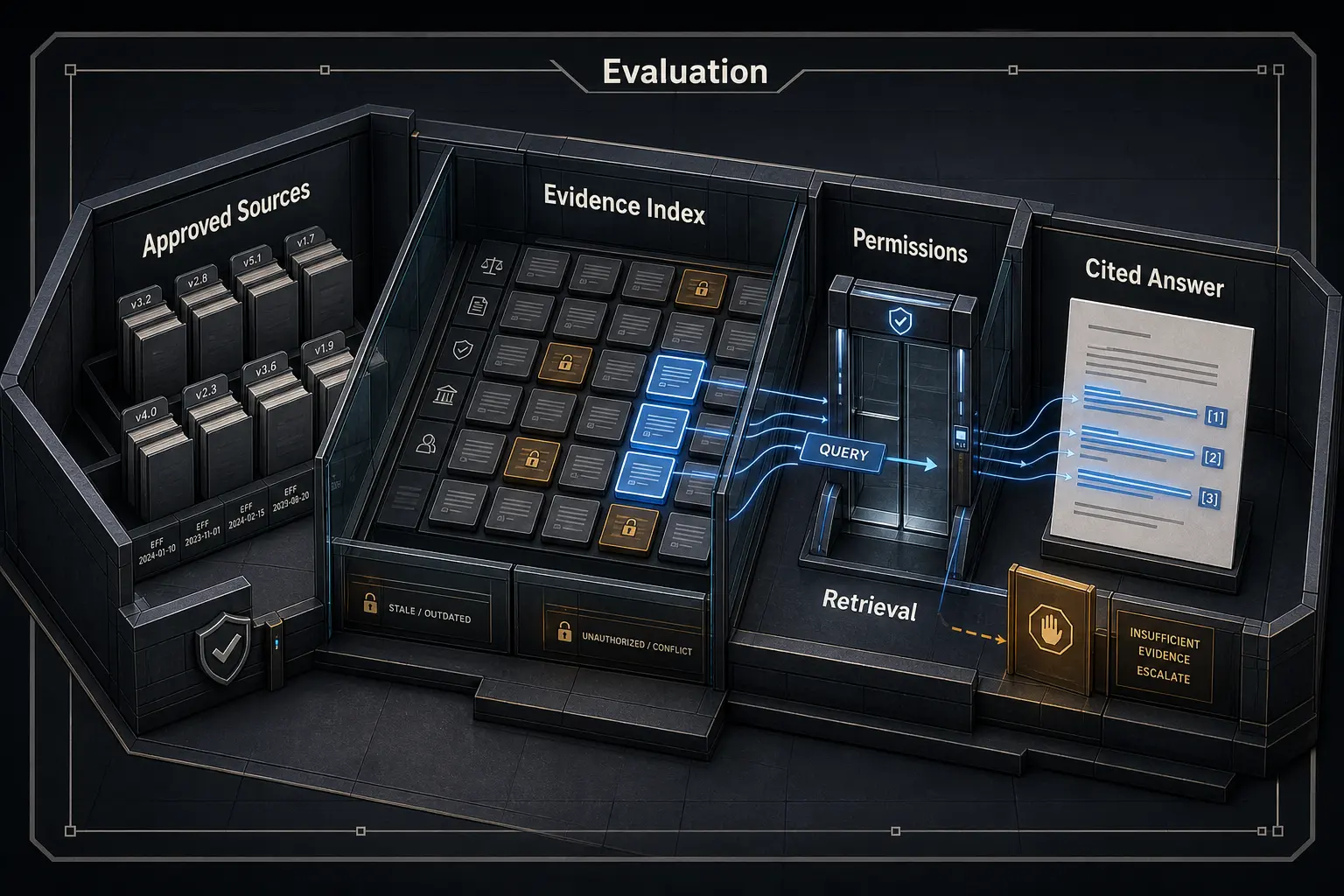
A dependable RAG implementation is an end-to-end evidence system: it keeps source knowledge current, retrieves relevant and authorized material, generates answers grounded in that material, preserves traceability, and fails safely when evidence is insufficient. A typical prompt-and-vector-search demo mainly shows that the basic pattern can work under controlled conditions, not that the system is production-ready. It does not prove production reliability.
The practical challenge is a chain of connected decisions rather than a choice of database, embedding model, or framework. Parsing affects chunking; chunking affects retrieval; metadata affects permissions and freshness; retrieval affects generation; and workflow integration determines whether the output is useful or risky. The system therefore needs to be designed from the use case outward, with evaluation defined before complexity is added.
Table of Contents
- What a Production RAG Implementation Requires
- Design the RAG Architecture Around the Workflow
- Build the Ingestion and Indexing Pipeline
- Design Retrieval, Citations, and Answer Generation
- Integrate RAG with Permissions and Business Workflows
- Evaluate, Monitor, and Improve the RAG System
- FAQ
- What to Do Next?
What a Production RAG Implementation Requires
Retrieval-augmented generation combines external retrieval with language-model generation. The core sequence is straightforward: acquire knowledge, process it, create a searchable index, retrieve evidence for a request, generate a response from that evidence, and map the response back to its sources. The difficult part is making every stage dependable under changing documents, inconsistent queries, access restrictions, and operational failures.
This pattern is useful when answers depend on private, domain-specific, or frequently changing knowledge that should not be assumed to exist reliably in model parameters. A complete retrieval augmented generation implementation does more than make documents searchable. It must answer a stricter question: can the system find current, sufficient, authorized evidence for this user and task?
Consider a hypothetical internal policy assistant. A demo containing ten clean documents may answer common questions convincingly. A production version must distinguish active policies from superseded versions, apply department and regional permissions, detect conflicting passages, cite the correct clause, and decline questions for which no approved source exists. Fluency is not the acceptance criterion. Evidence, authorization, freshness, and workflow fit are.
Production requirements commonly include:
- Defined source ownership and update behavior
- Reliable parsing, indexing, invalidation, and deletion
- Permission-aware retrieval and traceable citations
- Acceptable latency and controlled failure behavior
- Layered evaluation, logging, monitoring, and operational ownership
Retrieval failure and generation failure must remain distinguishable. If the correct policy never reaches the model, changing the answer prompt will not repair the system. If the correct evidence is present but the response misinterprets it, increasing the retrieval candidate count may only add noise. This separation is essential for diagnosis.
RAG is also a poor fit for some problems. Tasks that do not require external knowledge may need only a model call or deterministic logic. Highly structured facts may belong behind a database query or API. Sources that are contradictory, unowned, or too inconsistent to support an authoritative answer need knowledge governance before retrieval technology.
Design the RAG Architecture Around the Workflow
Good RAG architecture starts with the user task. “Answer questions about company documents” is too broad. A useful boundary might be “help employees understand currently approved leave policies while respecting regional access rules and escalating ambiguous cases.” That definition clarifies the users, knowledge sources, response limits, and consequences of an incorrect answer.
Before selecting components, document the approved sources, their owners, expected update frequency, user identities, access rules, typical queries, required response format, and acceptable fallback behavior. Decide whether the application is answering questions, comparing documents, drafting support replies, assisting research, or feeding another workflow. Each task creates different retrieval and output requirements.
RAG system design normally contains two distinct processing paths. The indexing path runs asynchronously or on a schedule: connectors acquire documents, parsers extract content, normalization preserves useful structure, chunks are created, embeddings or other searchable representations are produced, and records are written to indexes and metadata stores. The request-time path authenticates the user, interprets the query, applies authorization filters, retrieves and optionally reranks evidence, constructs context, invokes the model, assembles citations, validates the output, and records diagnostic events.
Typical components include source connectors, a parser, normalization and chunking stages, an embedding process, a lexical or vector index, metadata storage, a retriever, an optional reranker, an LLM, a citation mapper, an application layer, and logs. Not every implementation needs every component. A small document collection with strong keyword identifiers may perform well with lexical search and metadata filters, while another corpus may justify hybrid retrieval.
Structured systems of record should usually remain structured. If an employee asks for their remaining entitlement, a deterministic API or database query is a better authority than an embedded text snapshot. Retrieval can explain the governing policy, while the transactional system supplies the employee-specific value. Flattening both into semantic text weakens freshness, precision, and accountability.
Define contracts between stages. Records should carry stable document and chunk identifiers, source versions, effective dates, ownership, access attributes, and ingestion status. Request-time results should preserve the retrieval method, applied filters, scores where useful, and source identifiers. Responses consumed by software should follow a validated schema. Orchestration coordinates these stages, but deterministic rules should own access checks, required fields, routing conditions, and transactional actions.
Build the Ingestion and Indexing Pipeline
The ingestion side of a RAG pipeline turns source material into retrievable evidence. Its quality is often underestimated because embedding malformed text still produces valid vectors. A valid vector does not mean the content retained its meaning.
Inventory source formats before indexing. Documents may contain nested headings, tables, scanned pages, lists, attachments, repeated headers, footers, navigation text, or multi-column layouts. Parsing should remove irrelevant repetition without discarding context. Normalized records should retain useful attributes such as title, section hierarchy, source identifier, owner, version, effective date, and access rules.
Chunking is a semantic and structural decision, not a universal character-count setting. Structure-aware chunking follows sections, clauses, paragraphs, or table boundaries. Fixed-size chunking is simpler but can divide related ideas arbitrarily. Overlap can preserve continuity, although excessive overlap creates duplicate results. Parent-child retrieval can search compact child chunks and then supply a larger parent section. Contextual enrichment can add headings or document titles to chunks that would otherwise be ambiguous.
Suppose a policy manual states a general rule in one paragraph and a regional exception immediately below it. A fixed split may separate the exception from the rule it qualifies. Retrieval could then return the rule alone and produce an incorrect answer. A structure-aware chunk can preserve the heading, rule, and qualifying clause together, or link the smaller result to its parent section.
Chunks that are too small lose context and become difficult to interpret. Chunks that are too large dilute relevance, consume more of the generation context, and make citations less precise. The right strategy depends on document structure, expected question granularity, and the evidence needed to answer. Representative chunks should be inspected manually before ingestion is scaled.
Embedding and indexing configurations need versions. Store enough information to identify the parser, chunking rules, embedding configuration, source version, and index generation associated with each record. This supports deliberate re-indexing and rollback rather than an opaque rebuild.
Updates require more than adding new content. The pipeline should detect duplicates, replace superseded versions, propagate deletions, and represent invalidated records so they cannot remain retrievable. Failed documents need a visible ingestion state and a retry or review path. Authorization metadata must also be attached or reliably resolvable before retrieval. Retrofitting access control after an unrestricted index is serving requests creates a security problem, not merely a metadata task.
Design Retrieval, Citations, and Answer Generation
The request-time path should be decomposed into testable stages: query handling, candidate retrieval, ranking, context construction, generation, validation, and citation mapping. Treating the path as one opaque model operation makes failures difficult to locate.
Query normalization or classification is useful only when it improves retrieval. Preserve the original question for auditability even if the system expands abbreviations, resolves known terminology, or creates alternate search queries. Query rewriting can help conversational or underspecified requests, while decomposition can help questions requiring evidence from several sources. Both can also alter intent, so they should be evaluated rather than enabled by default.
Different retrieval methods solve different problems. Lexical search handles exact codes, names, and uncommon terms well. Semantic retrieval finds conceptually similar passages despite different wording. Metadata filtering restricts results by attributes such as region, document type, effective date, or permission. Hybrid retrieval combines lexical and semantic candidates when the query set benefits from both.
For example, a request containing an exact policy code and a natural-language question may need all three mechanisms. Lexical retrieval locates the code, semantic retrieval finds related guidance, and metadata filters limit candidates to the user’s region and the current policy version. A reranker may then improve ordering, but only if evaluation shows that initial retrieval finds the right evidence and ranks it poorly.
Retrieve a bounded candidate set and pass only useful evidence into the model context. Similarity scores are ranking signals, not complete measures of relevance or confidence. A high score does not prove that a passage is current, authorized, sufficient, or responsive to the user’s exact task.
Keep retrieval instructions separate from answer-generation instructions. The generation step should be told to use the supplied evidence, attribute material claims, identify conflicts, and state when evidence is missing. If another workflow consumes the output, structured fields can represent answer status, evidence identifiers, escalation reasons, and requested actions.
Citations should be assembled from stable document and chunk identifiers preserved by the retrieval augmented generation implementation. Asking the model to construct references from source text invites mismatches. Even correctly mapped citations prove only which evidence was presented; they do not prove that the answer interpreted it correctly. Citation accuracy and claim support still require evaluation.
Fallback behavior must be explicit. Empty results should not become a confident answer from model memory. Weak evidence may require a bounded refusal or alternate search. Conflicting approved sources may require a visible conflict notice and escalation. Malformed structured output should trigger validation and a controlled retry or failure response, not silent downstream processing.
Integrate RAG with Permissions and Business Workflows
Enterprise RAG is defined by governance and operational controls, not merely by corpus size. Identity and authorization must constrain retrieval before source text enters the model context. Filtering only the final answer is inadequate because restricted material may already have reached downstream model infrastructure, application traces, caches, or logs.
Permissions should come from a trusted identity and policy layer, never from claims inside the user’s prompt. Depending on the access model, authorization may be enforced through metadata filters, separate indexes, retrieval-time policy checks, or combinations of these. The system must also prevent cross-user leakage through shared caches and conversation state.
Knowledge retrieval should remain separate from transactional action. In a support-assistance workflow, RAG might retrieve approved troubleshooting guidance and draft a response. If the customer requests an account change, a separate authenticated API should validate identity, business rules, and required approval. The retrieval system informs the decision; it does not automatically gain authority to perform every available action.
Define whether each output is advisory, approval-dependent, or actionable. Structured outputs can route results using fields such as answer status, evidence identifiers, escalation reason, and requested operation. Deterministic logic should reject missing fields, enforce policy, and stop the workflow when authorization or evidence is insufficient. Human review belongs where consequences, ambiguity, or policy interpretation require accountable judgment.
Operational integration also requires timeouts, retries, rate-limit handling, credential management, and queues where workloads cannot complete synchronously. Downstream actions should be idempotent so a retry does not create duplicate changes. Caching needs boundaries that account for document versions, user permissions, and source freshness rather than reusing an answer solely because the wording looks similar.
Logs should capture enough context to diagnose failures without retaining unnecessary sensitive text. Useful events include authenticated identity references, applied filters, source and chunk identifiers, component versions, validation outcomes, latency, and failure categories. Retention and redaction should reflect the sensitivity of the application.
Retrieval alone does not make the system an AI agent. An agentic layer is justified only when a task requires bounded tool selection, multi-step information gathering, or delegated decisions. That addition introduces state, broader permission questions, observability requirements, and recovery paths. A deterministic retrieval workflow is often easier to test and safer to operate.
Evaluate, Monitor, and Improve the RAG System
Evaluation should begin before launch with a representative set of tasks. Include normal questions, ambiguous wording, outdated terminology, permission-sensitive requests, conflicting sources, and questions with no valid answer. Where possible, record the expected source evidence as well as an acceptable answer. This allows retrieval to be evaluated independently of response style.
Measure whether relevant evidence was found, whether unauthorized or superseded content appeared, whether the response was supported, and whether citations mapped to the claims they accompanied. Human review remains necessary for nuanced domain interpretation and practical usefulness. One automated score cannot establish factual support, security, citation quality, and workflow suitability at once.
A useful failure taxonomy separates:
- Ingestion, parsing, chunking, and metadata failures
- Permission, query interpretation, retrieval, and ranking failures
- Context assembly, generation, validation, and citation failures
- Application integration, dependency, timeout, and action failures
Suppose the system produces a fluent but outdated answer. The old document may still be indexed, an effective-date filter may have failed, the current passage may have ranked below stale content, or the model may have ignored better evidence already in context. Each cause requires a different repair. Rewriting the prompt across all four cases would hide the distinction.
Tests should also cover prompt injection embedded in retrieved documents, duplicate content, empty results, stale indexes, conflicting sources, malformed parser output, unavailable dependencies, and latency spikes. Retrieved text is untrusted input; an instruction inside a document should not be allowed to override system rules or authorize tool use.
Production monitoring can track source freshness, ingestion failures, retrieval behavior, unsupported-answer events, user corrections, permission denials, latency, and system errors. Definitions should fit the application. A refusal may be a failure in one workflow and the correct safe outcome in another.
Version prompts, chunking rules, embedding configurations, indexes, filters, and evaluation sets. RAG system design should make these artifacts comparable and reversible. Change one layer deliberately, rerun the evaluation set, and check for regressions across users and query types. Add hybrid search, reranking, decomposition, or agentic behavior only when a measured failure indicates that the added mechanism addresses the weak layer.
FAQ
What is the difference between RAG and fine-tuning?
RAG supplies external evidence at request time, while fine-tuning changes model behavior or learned patterns. They solve different problems and can coexist. Frequently changing factual knowledge generally favors retrieval; specialized response behavior may justify fine-tuning after the need has been evaluated.
Does RAG require a vector database?
No. Retrieval can use lexical search, relational databases, document search, graph structures, APIs, vector search, or a combination. The right mechanism follows the knowledge type and query pattern rather than the RAG label.
How should chunk size be chosen for RAG?
Choose an initial strategy from the document structure and expected answer granularity, then test it. Good chunks preserve meaning, retrieve precisely, and provide enough surrounding context without filling the model input with unrelated material. There is no universal size or overlap percentage.
When should a RAG system use an AI agent?
Ordinary retrieval and answer generation do not require an agent. Agentic behavior may help when the system must choose among bounded tools or plan multi-step information gathering. It also creates additional requirements for state, permissions, observability, human approval, and failure recovery.
How can RAG handle conflicting or outdated sources?
Use source ownership, effective dates, version metadata, precedence rules, invalidation processes, and retrieval filters. When approved sources genuinely conflict, the answer should expose the conflict and follow a defined escalation path. The model should not silently decide organizational policy.
What to Do Next?
Start with one workflow, one user group, and an approved source set. Create a one-page specification covering source ownership, update behavior, permissions, expected questions, indexing and request-time paths, chunk metadata, retrieval methods, output schema, citation behavior, failure states, logs, and human review.
Build the simplest prototype that satisfies that specification. Test normal, difficult, unauthorized, outdated, ambiguous, and unanswerable queries, then inspect the retrieved evidence before optimizing generation. Classify each failure by layer and revise the weakest component. Add hybrid retrieval, reranking, query decomposition, or agentic tool use only when evaluation demonstrates a specific need.