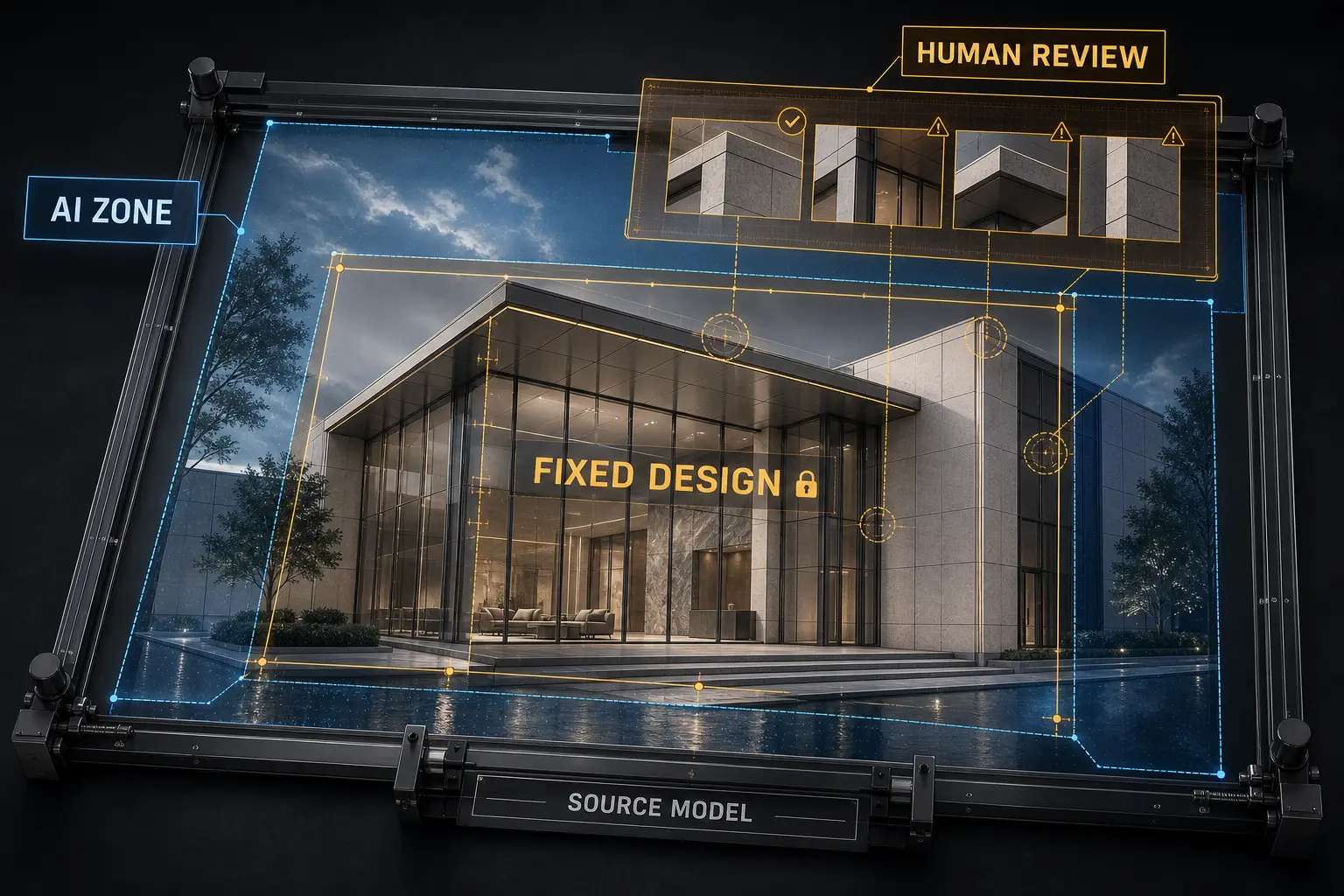
The value of ai for architectural visualization depends on the production task. AI can accelerate visual exploration, support image treatment, and assist with repetitive production work, but speed does not guarantee architectural correctness, image-set consistency, or revision-ready output. A convincing image may still contain altered geometry, invented details, inconsistent materials, or a camera interpretation that no longer represents the approved design.
The practical question is not whether AI belongs in visualization, but what it should be allowed to change. A controlled approach identifies which information must remain exact, which visual qualities are open to exploration, and where human approval is required. That distinction makes it possible to assess useful applications, anticipate failure modes, and build a hybrid workflow around design fidelity rather than novelty.
Table of Contents
- How AI for Architectural Visualization Fits the Production Pipeline
- Production Requirements AI Must Respect
- Where AI Adds Real Production Value
- Building a Controlled AI Rendering Workflow
- Failure Modes and Quality Control
- Deciding Where Human Judgment Matters
- FAQ
- What to Do Next?
How AI for Architectural Visualization Fits the Production Pipeline
AI for architectural visualization is best understood as a collection of capabilities, not a replacement for the complete visualization pipeline. It includes generative image systems, AI-assisted editing, classification and analysis, search assistance, and production support. These capabilities behave differently and should not be grouped under a single promise of automated rendering.
A key distinction is between probabilistic generation and deterministic operation. A generative system produces a plausible interpretation, so its result can vary even when the input is similar. Deterministic automation follows defined rules and can handle routine file and workflow operations without interpreting the architecture. Both can support production, but they solve different problems.
In practice, AI has three broad roles. It can support exploration by generating possible moods, atmospheres, or reference directions. It can assist specific image operations such as masking, cleanup, enlargement, or localized treatment. It can also sit inside controlled production support, provided its input, permitted changes, review criteria, and fallback path are clearly defined.
The intended use determines whether an output is good enough. A mood image for an internal discussion can tolerate ambiguity. A design-review image must communicate spatial relationships and material intent more carefully. A final marketing image may need both visual refinement and strict continuity with the approved architecture. The same AI output could be useful in the first context and unacceptable in the third.
Consider a lobby study. AI can help test warm evening light, diffuse daylight, or a restrained hospitality atmosphere before the art direction is fixed. Variation is useful at that stage. If the final frame must preserve the approved camera, ceiling coffers, joinery lines, openings, furniture selection, and stone layout, unrestricted generation becomes a poor production method. The image is not merely a picture; it is a production artifact tied to design information.
Production Requirements AI Must Respect
Professional visualization depends on invariants: information that must survive every operation unchanged unless a revision explicitly authorizes a change. Depending on the project stage, these may include geometry, dimensions, spatial relationships, camera position, lens character, material assignments, lighting intent, landscape placement, furniture selections, and approved details. Before using AI visualization, the team must know which elements are fixed.
Architectural correctness is not the same as visual plausibility. A generated façade may look credible while changing window proportions, thickening slabs, simplifying mullions, or inventing a joint between materials. In AI rendering for architecture, visual polish can make such errors harder to detect because the image feels coherent at first glance. Professional acceptance therefore requires comparison with the design source, not merely an assessment of realism.
Consistency is another production requirement. A single successful frame does not establish a dependable method. A three-image residential set may need the same brick, window system, planting strategy, weather, and color response across exterior views. Animation demands tighter continuity because small changes between frames appear as flicker or shape instability. Early exploration can tolerate variation; approved image sets generally cannot.
Revision control exposes the difference between an attractive result and a production-ready one. Suppose a façade material changes after review. A controlled process should update that material without changing window sizes, landscaping, camera composition, or time of day. If the only option is to regenerate the whole image and hope everything else remains stable, the workflow has weak editability and poor traceability.
Accuracy alone is not enough. Composition, visual hierarchy, atmosphere, depth, and narrative emphasis determine whether an image communicates the architecture clearly. A technically faithful frame can still fail if the camera hides the main spatial idea, the lighting flattens material relationships, or the entourage competes with the building. Human direction is needed not merely to correct errors, but to decide what the image should communicate.
Where AI Adds Real Production Value
AI contributes most when the task is bounded, the source material is strong, variation has a purpose, and the result can be reviewed quickly. This makes early mood exploration a natural fit. Before a production team commits to detailed lighting, materials, and post-production, generative AI architecture studies can test broad directions such as crisp winter daylight, humid evening atmosphere, or a quiet overcast treatment.
Reference development is another useful application. AI-generated studies can clarify an intended palette, contrast level, landscape character, or emotional register. They should be treated as visual references rather than design specifications. A reference may contain impossible geometry or inconsistent light yet still communicate an art-direction idea that can be rebuilt through a controlled scene.
For a hypothetical competition exterior, the massing and camera might come from an approved 3D model while AI is used to explore atmospheric treatments. The team can compare directions without assuming that generated cladding, planting, or façade detail is correct. Once selected, the direction becomes a target for lighting and post-production rather than an unquestioned final image.
Constrained image assistance can also be valuable later in production. Possible tasks include localized cleanup, mask preparation, enlargement, selected entourage treatment, texture-search assistance, or adjustment of a non-critical background region. Each operation should have a narrow area of effect. A sky replacement is easier to verify than a request to reinterpret an entire façade while preserving every opening.
Not every useful operation involves generative imagery. Text and metadata support can help organize review notes, classify outputs, or prepare descriptions. Deterministic automation can handle naming, format conversion, file routing, and status handoffs more reliably than a generative model. A sound AI rendering workflow often combines several methods rather than forcing every task through image generation.
Any claimed speed benefit must account for comparison, rejected outputs, cleanup, and review. Producing many options quickly is not valuable if none respects the brief or if checking them takes longer than building the result conventionally. Low-risk, reversible experimentation creates value because weak outputs can be discarded without damaging the controlled source.
Building a Controlled AI Rendering Workflow
A controlled AI rendering workflow starts before an AI operation occurs. The brief should classify requirements as fixed, flexible, or undecided. Fixed information might include geometry, camera, approved materials, and key furniture. Flexible qualities could include atmosphere, cloud character, minor background activity, or color treatment. Undecided elements are legitimate design questions that require exploration rather than accidental resolution by an image system.
The next step is to establish controlled source material. Depending on the image, this may include an organized 3D scene, locked cameras, base lighting, assigned materials, render passes, object masks, depth information, and reference images. Strong source material gives the AI operation boundaries and provides a reliable point of comparison. It also keeps later revisions connected to editable scene information.
Each AI task should have a defined input and expected output. “Improve this render” is not a production specification. “Introduce restrained morning haze outside the glazing while preserving the interior, view, mullions, and exposure relationship” establishes a clearer boundary. Even then, the result needs inspection because a narrow instruction does not guarantee a narrow transformation.
For a façade image, the sequence could be straightforward: lock the geometry and camera in 3D, render a base image with useful masks, apply AI only to bounded atmospheric or entourage areas, compare the result with the source, and composite accepted regions into layered production files. The original render, masks, and versions remain available when the façade material or landscape is revised.
Repeatedly editing generated outputs is risky. Each generation can introduce small deviations, and later edits may preserve those deviations while adding new ones. After several rounds, it becomes difficult to identify when a balustrade changed, a reflection disappeared, or a window module shifted. A reliable process returns to controlled source material and reapplies approved treatments rather than building indefinitely on degraded generations.
Versioning and approval points complete the workflow. Inputs, generated variants, selected regions, and composited outputs should remain distinguishable. Human review should occur before an AI-modified image becomes the source for another production stage. Meanwhile, deterministic automation can prepare folders, apply naming rules, route previews, and record status without being asked to judge visual intent.
Failure Modes and Quality Control
AI-modified images often fail through details that remain individually plausible. Common problems include geometry drift, altered openings, inconsistent dimensions, impossible junctions, invented construction details, material substitution, missing reflections, and changed camera characteristics. Entourage may be duplicated or malformed, while signs and typography can become corrupted. Across related views, the same building element may receive a different interpretation in each image.
Lighting errors deserve separate attention. A generated treatment may introduce a bright sky without changing the direction or softness of light on the building. Reflections may describe a different environment from the visible context. Interior fixtures may glow while contributing no illumination, or façade shadows may contradict the intended sun direction. These inconsistencies weaken an image even when viewers cannot immediately identify the cause.
Consider an interior revision intended only to improve atmosphere. The result feels warmer and more occupied, but the stair balustrade has changed, two ceiling slots have disappeared, and the chair count is different. A full-image impression check may approve the mood while missing the design errors. Region-by-region comparison exposes them.
A practical quality-control sequence begins with architectural fidelity: geometry, openings, junctions, dimensions, and approved details. It then checks camera and composition, followed by materials, textures, lighting, and reflections. Entourage, landscape, signage, and contextual detail come next. Finally, the image should be compared with every related view for continuity of materials, weather, design elements, and color treatment.
Side-by-side comparisons are useful, but overlays and difference views can reveal shifts that memory misses. Crops help reviewers inspect high-risk regions at an appropriate scale. Masks can isolate the area intended to change, while version checks confirm that the correct source and revision were used. Review should prioritize approved, visible, or costly-to-correct elements rather than treating every artifact as equally significant.
Human review reduces risk; it does not guarantee complete accuracy. Reviewers can miss plausible errors, especially under deadline pressure or after seeing many variants. Quality control is stronger when acceptance criteria are defined before generation and AI visualization outputs are checked against controlled design information rather than judged in isolation.
Deciding Where Human Judgment Matters
A production method can be evaluated with five questions. What information must remain invariant? How much variation is acceptable? Can the result be checked quickly and objectively? Must it remain editable for revisions? What is the consequence of a subtle error? These questions apply whether the proposed method is generative AI, conventional rendering, post-production, or deterministic automation.
AI is a stronger fit when variation is useful, the intervention is reversible, and review costs are low. Conventional 3D and deterministic methods remain stronger when geometry, continuity, repeatability, or downstream editability dominate. A hybrid process is appropriate when a controlled scene establishes the architecture and bounded AI operations contribute atmosphere or detail without becoming the authority for the design.
Compare three tasks. Exploring dawn versus overcast mood suits bounded AI exploration because controlled variation supports the decision. Replacing an approved façade system belongs in the editable 3D scene because dimensions, joints, reflections, and continuity must remain dependable. Organizing render outputs belongs in deterministic automation because creative interpretation would add uncertainty rather than value.
This framework also clarifies the role of AI for architects and visualization teams. Human judgment interprets the brief, establishes visual hierarchy, selects the camera, directs atmosphere, balances realism against abstraction, and decides whether the image communicates the design honestly. These are not merely cleanup tasks after generation. They shape the purpose and meaning of the visualization.
Responsible use of AI for architectural visualization depends on production boundaries. AI should be given freedom where variation creates insight and constrained where variation creates risk. The goal is not to maximize the amount of AI in the pipeline, but to choose the method that preserves design intent, supports revision, and produces an image that can be approved with confidence.
FAQ
Can AI replace architectural visualization artists?
AI can perform or assist with bounded tasks, but professional visualization also requires interpretation of design intent, spatial understanding, composition, creative direction, consistency management, revision handling, and accountable quality control. The relevant question is which tasks can be delegated without weakening those responsibilities, not whether image generation replaces the complete discipline.
How can AI images maintain architectural accuracy?
Start with controlled geometry and cameras, restrict the transformation, preserve source files, and use masks or reference constraints where appropriate. Validate the result against approved drawings, models, materials, and design details. Constraints reduce the area in which errors can occur, but they do not remove the need for visual and architectural review.
Is AI better for concept images or final renders?
Concept stages generally tolerate more variation, making them a stronger fit for broad AI exploration. Final renders require greater accuracy, consistency, traceability, and editability. AI can still contribute to final production, but it should usually be assigned narrow operations whose results can be isolated, checked, and revised.
What makes an AI rendering workflow revision-ready?
A revision-ready workflow retains the 3D source, locked cameras, separated layers or masks, versioned outputs, and documented approvals. It should allow one element to change without regenerating unrelated parts of the image. Repeatable steps and clear source ownership matter more than preserving a long sequence of prompts.
When should AI not be used for architectural images?
A generative method is a poor fit when exact geometry must be demonstrated, subtle errors carry serious consequences, outputs must be reproduced consistently, or revisions require precise element-level control. It should also be avoided when verifying and correcting the generated result would require more effort than using a conventional workflow.
What to Do Next?
Choose one real production stage rather than redesigning the entire pipeline. Map the task from controlled input to approved output, then label each requirement as fixed, flexible, or undecided. Select a low-risk, reversible AI intervention and define the architectural and visual acceptance checks before testing it.
Retain the controlled source, record where human approval is required, and compare the AI-assisted path with the existing process. Evaluate correction effort, consistency, editability, and revision behavior as well as initial speed. If deterministic automation or the existing method provides better control for that task, it is the better production decision.